BLACK FRIDAY DEAL: 25% OFF THE ENTIRE COLLECTION
Diamond cut quality and why one stone sparkles more than another
Turn your hand slightly and watch one facet light up, then another. Two diamonds of the same carat weight, colour and clarity can look quite different in motion. Their cut determines how lively those flashes appear.
You choose the colour and clarity. We look for the sparkle you will see when you wear your jewellery. That is why we select Triple Excellent for the white round brilliants in our standard selection.
Watch the diamonds as they tilt
Start with the centre of the stone on the left. Its rim catches the light while the centre stays quieter. As the stone on the right tilts through the same angle, facets light up across its centre too. Each dark facet makes the next bright flash stand out.


What does DiamondsByMe select for you?
Our standard white round brilliants earn Excellent for three things. Cut describes the overall quality of the cut. Polish tells you how smoothly the facets are finished. Symmetry describes how precisely their shapes and positions align. Together these grades are called Triple Excellent, or XXX.
Our full designation is XXXN. N stands for None, meaning no fluorescence under UV light. Fluorescence is a separate characteristic. We use the same criteria for natural and lab-grown white round brilliants.
For other white diamond shapes, including oval and pear, we use XXN. Reports for these shapes often omit an overall cut grade. We select Excellent polish and symmetry, proportions that suit the shape, and no fluorescence.
What can you check on your diamond report?
For round diamonds weighing 0.30 carats or more per stone, you receive an independent grading report. For other shapes this usually applies from around 0.50 carats per stone. You can check your own diamond’s colour, clarity and cut assessments there.
Natural diamonds usually come with a GIA report and sometimes an HRD report. Lab-grown diamonds come with an IGI report. This also applies to coloured lab-grown diamonds. Natural coloured diamonds fall outside this arrangement.
Read more about diamond grading reports
Why does one diamond catch more light?
The little flat surfaces are called facets. They act like mirrors. At the right angles they send light back towards your eye. As your hand turns, a different facet catches the light. In sunlight or under a lamp you may also see flashes of colour, known as fire.
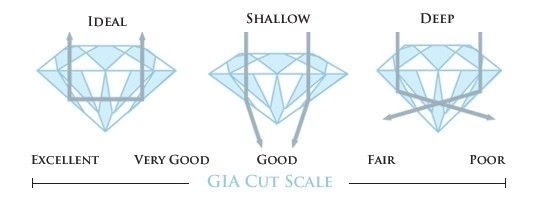
Follow the arrows in the diagram. On the left the light returns through the top. In the shallow and deep stones some light escapes through the bottom, so those areas may look dull from above.

The anatomy of a diamond
Look at a round brilliant from the side. These five features will help you find your way around the diagram and the proportions on your grading report.

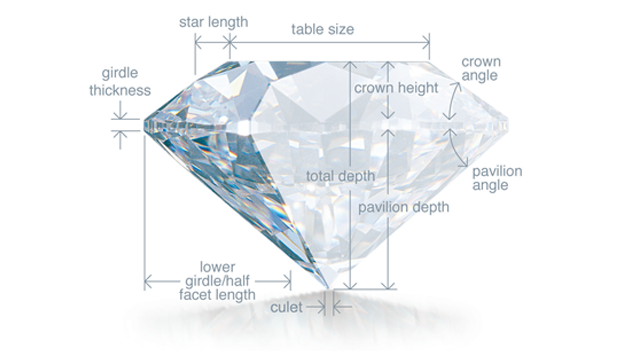
- Table. The large flat facet on top. Looking straight down, you see it in the centre surrounded by smaller facets.
- Crown. The sloping upper part between the table and the rim. You can often see small flashes of colour here as the stone moves.
- Girdle. The narrow rim at the diamond’s widest point, where the jeweller can secure it. A very thin girdle is more vulnerable to chipping.
- Pavilion. The lower part that tapers towards the tip. Its facet angles help determine how much light returns through the top.
- Culet. A tiny flat facet sometimes present at the bottom. When the facets meet in a point, the report can list the culet as None.
Which table and depth percentages suit your diamond?
Table percentage describes the width of the top facet. Depth percentage describes the total height of the stone. For a round brilliant both are measured against its average diameter. A 6 mm stone with a 3.6 mm table has a table percentage of 60%.
The table gives guidelines for nine shapes. Compare stones of the same shape. Two stones within the same ranges can sparkle differently because the angles and arrangement of their facets also matter.
| Shape | Table percentage | Depth percentage |
|---|---|---|
| Round | 56–63% | 58–62.3% |
| Princess | 65–75% | 65–75% |
| Cushion | 61–68% | 58–68% |
| Emerald | 61–68% | 58–68% |
| Asscher | 60–68% | 60–68% |
| Oval | 55–63% | 58–62% |
| Marquise | 53–62% | 58–62% |
| Radiant | 61–68% | 61–68% |
| Pear | 53–62% | 58–62% |
How to read the cut grade on your report
Compare two round brilliants side by side in the same light and tilt them slowly. Watch where each one lights up and where it stays dull. GIA uses five cut grades for natural standard round brilliants.
- Excellent – Bright and dark facets form a balanced pattern. As you turn your hand, crisp flashes appear in different places. This is GIA’s highest grade and our standard for white round brilliants.
- Very Good – The diamond sparkles brightly. Beside an Excellent stone you may see a small area light up less often during the same movement.
- Good – There are distinct flashes, although their edges may look softer. Some areas can stay darker as the stone tilts.
- Fair – A few facets can still flash brightly while larger areas stay dull.
- Poor – Much of the stone can look dull. Even in motion, there may be little change between light and dark.
What does Ideal mean?
IGI uses Ideal for round brilliants with carefully cut proportions. An IGI report can show Excellent under cut grade and Ideal Cut in the comments. Excellent is already GIA’s highest grade. When comparing reports, check which laboratory issued each one.
Explore other diamond characteristics
Round, oval and pear describe a diamond’s outline. Cut quality describes how well that shape has been cut. Explore the shapes or compare the other three Cs.